
Jiu-Jitsu Belt Rank: Your Guide to the BJJ Belt System and Progression

You've watched a brand-new student tie their white belt for the first time—loop too loose, tail hanging past their knee—and something about that moment never gets old.
The belt system is one of the first things every prospective member asks about, and one of the biggest reasons students stay for years.
But here's what most guides won't tell you: the BJJ belt system isn't just a ranking ladder.
For academy owners, it's a retention framework, a teaching roadmap, and a culture-builder rolled into one. How you manage promotions shapes how your students feel about training—and whether they stick around long enough to earn that next stripe.
This guide breaks down every belt rank in Brazilian Jiu-Jitsu—from white through black, coral, and red—along with IBJJF requirements, stripe rules, youth belt colors, and practical advice for running a promotion system that keeps your academy growing.
Key Takeaways
- The BJJ belt system has five adult ranks—white, blue, purple, brown, and black—each with minimum age thresholds and, from blue belt onward, minimum time-in-grade set by the IBJJF.
- Stripes (up to four per belt) mark progress between promotions and give students visible milestones to work toward.
- Youth belts follow a different color sequence with narrower age bands, and the Gracie system adds its own variations.
- The typical journey from white to black belt takes 8–12 years, though the IBJJF's minimum time-in-grade from blue to black adds up to just 4.5 years.
- Blue belt is the highest-attrition rank—structured retention tactics at this stage can make or break your academy's growth.
- A clear, published promotion system standardized across your instructors builds trust and keeps students engaged.
BJJ Belt System Overview
The Brazilian Jiu-Jitsu belt system is one of the most structured ranking frameworks in martial arts.
Unlike striking-based arts where belt tests happen on a fixed schedule, BJJ promotions are earned through demonstrated skill, mat time, and competition performance.
Your instructor's judgment carries real weight here.
The International Brazilian Jiu-Jitsu Federation (IBJJF) sets the minimum standards, but individual academies have wide latitude in how they evaluate readiness. That flexibility is one of the system's strengths—and one of its biggest management challenges.
Here's a quick-reference overview of all five adult belt ranks:
Belt | Color | Min Age | Min Time at Previous Belt | Stripes |
White | White | No minimum | N/A | 0–4 |
Blue | Blue | 16 | No IBJJF time minimum | 0–4 |
Purple | Purple | 16 | 2 years at blue | 0–4 |
Brown | Brown | 18 | 1.5 years at purple | 0–4 |
Black | Black | 19 | 1 year at brown | 0–6 (degrees) |
PRO TIP:
Print a version of this table and hang it in your academy lobby. When prospective members ask "how long does it take?"—and they always ask—you can walk them through the system in 60 seconds. It sets expectations early and shows your school takes progression seriously.
Adult Belt Ranks in Brazilian Jiu-Jitsu
The adult system runs through five colors, and each one marks a distinct phase of a student's development—from raw survival to refined, personal jiu-jitsu. Here's what happens at every rank, and what it means for the students you're trying to keep.
White belt: Where every journey starts
Every student begins at white belt, regardless of experience in other martial arts.
It's the great equalizer—a former college wrestler and a total beginner both start here.
At this stage, students are learning to survive. Basic positions, fundamental escapes, a handful of submissions, and how to move on the ground without panicking. Most white belts spend two to three years at this rank, though some progress faster with consistent training.
For gym owners, white belt retention is about managing expectations.
New students often come in with unrealistic timelines—they've watched UFC highlights and expect to be submitting training partners within weeks.
Your job is to channel that enthusiasm into consistent habits and achievable milestones.
The four-stripe system at white belt is especially valuable here. Each stripe gives your students a tangible marker of progress before that first big promotion to blue.
Blue belt: Building your technical base
Blue belt is where BJJ gets real. Students have enough skill to start developing a game, experimenting with techniques, and understanding why positions matter—not just what to do from them.
It's also where your academy faces its biggest retention challenge.
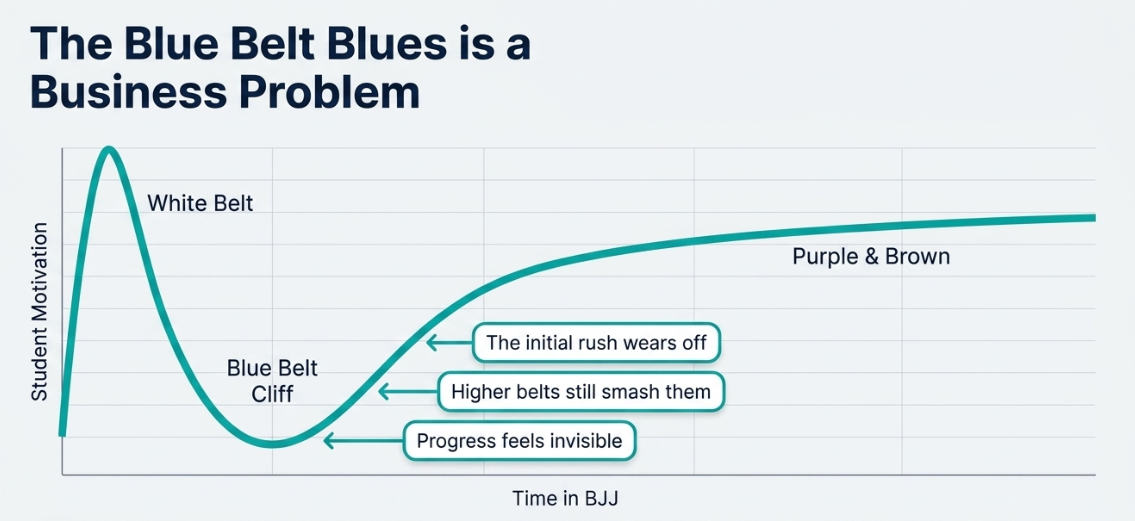
The "blue belt blues" is one of the most discussed phenomena in jiu-jitsu. After the excitement of earning that first colored belt, many students hit a plateau.
The initial rush of learning wears off.
Higher belts still smash them. Progress feels invisible. And life—work, family, injuries—starts competing for mat time.
The numbers don't lie: blue belt is the rank where the most students quit. If you're running an academy, your retention strategy at this stage matters more than at any other belt level.
Here's what works:
- Publish a progression roadmap. Students who can see what's ahead stay longer than students who feel lost. Map out the core techniques and concepts expected at each stripe level.
- Run quarterly one-on-ones. A 10-minute conversation about where a student is and where they're headed does more for retention than any marketing campaign.
- Assign mentor rounds. Pair blue belts with upper belts during drilling. It gives them a reference point and builds relationships across rank.
- Track small wins. When a student hits 100 classes, lands their first competition submission, or masters a technique they've been drilling for months—acknowledge it. A member portal that tracks attendance and skills makes this easy to spot.
GYM OWNER TIP:
The blue belt plateau isn't a motivation problem—it's a visibility problem. Students don't quit because they stopped improving. They quit because they can't see their improvement. Use your curriculum tracking to show them specific skills they've gained in the last 90 days.
Purple belt: Intermediate mastery and personal style
Purple belt is the inflection point.
This is where a student's jiu-jitsu becomes theirs—not just a collection of techniques from class, but a coherent game with preferred positions, go-to submissions, and a distinct style.
Purple belts typically spend 18 months to three years at this rank.
They're the backbone of many academies—experienced enough to help newer students, creative enough to push training partners, and deeply invested in the art.
For gym owners, purple belts are your bench strength. Many are starting to consider teaching, and the ones who do often become your most valuable team members down the road.
The IBJJF requires students to be at least 16 years old and to spend a minimum of two years at blue before earning their purple belt.
Most academies exceed these minimums significantly.
PRO TIP:
Purple belts are often your most reliable comp team members. They're skilled enough to win matches and hungry enough to compete frequently. If you're building a competition program, invest in this group—help with tournament fees, run dedicated comp-class drilling sessions, and track their results.
Brown belt: Refinement and leadership
Brown belt is about polishing what you already know.
The major technical gaps are closed—now it's about timing, transitions, chaining techniques, and developing the ability to teach concepts clearly.
Most brown belts spend one to two years at this rank before black belt.
The IBJJF minimum time-in-grade at purple is 1.5 years, and brown belt carries a minimum age of 18.
Brown belts who teach are one of the biggest assets an academy can have. But compensation is a real conversation—one that many gym owners avoid until it becomes a retention problem of its own.
Pay varies widely by market and academy, but these illustrative models give you a starting point—for a fuller breakdown, see what BJJ instructors actually earn:
- Assisting classes: roughly $25–$50 per class
- Leading classes solo: roughly $40–$75 per class
- Hourly rate (private lessons or curriculum development): roughly $25–$35 per hour
- Monthly stipend (for consistent weekly teaching): roughly $200–$600 per month
The right model depends on your academy's size and revenue, but the principle is universal: if a brown belt is contributing to your teaching schedule, they should be compensated.
Free labor disguised as "giving back to the art" burns out your best people.
GYM OWNER TIP:
Don't wait until a brown belt asks about compensation. Bring it up proactively when they start assisting. Even a modest stipend signals that you value their time—and makes it far less likely they'll open their own academy across town.
Black belt: Expert level and a new beginning
Black belt in BJJ isn't the end of the journey—it's the start of a new one.
Unlike many martial arts where black belt represents basic competency, a BJJ black belt represents years of dedicated training, usually 8–12 years from white belt.
The IBJJF requires a minimum age of 19 and at least one year at brown belt.
Most black belts are in their late twenties or older by the time they're promoted.
Receiving a black belt often comes with an expectation—sometimes spoken, sometimes not—that you'll contribute to the art through teaching, competing, or both.
Many black belts eventually open their own academies, and the lineage system (who promoted whom) carries significant weight in the BJJ community.
If you're a gym owner who's also a black belt, your rank carries real credibility. If you're an owner who isn't a black belt yet, that's fine—what matters is having qualified black belt instructors on your team and the systems to support them.
Black belt degree progression
Black belt degrees (marked by red stripes on the belt) recognize continued contribution to the art over decades:
- 1st–3rd degree: Awarded at minimum three-year intervals. Most active black belts earn these through ongoing teaching and competition.
- 4th–6th degree: Requires minimum five-year intervals between degrees. At this level, practitioners have typically spent 20–30+ years in the art and are often school owners, federation leaders, or renowned competitors.
Beyond black: Coral and red belts
Beyond sixth-degree black belt, BJJ has some of the rarest ranks in any martial art.
The coral belt comes in two versions:
- 7th degree (red-and-black coral belt): Requires a minimum of seven years at sixth-degree black. These practitioners have spent 30+ years in jiu-jitsu.
- 8th degree (red-and-white coral belt): Requires a minimum of seven years at seventh degree. Only a small number of practitioners worldwide have ever reached it.
The red belt (9th and 10th degree) is reserved for the pioneers who shaped Brazilian Jiu-Jitsu itself.
- 9th degree red belt: Only a handful of living practitioners hold this rank. Recipients include members of the Gracie family and other foundational figures who've dedicated 50+ years to the art.
- 10th degree red belt: This rank has been awarded to only five people in history—the five Gracie brothers who pioneered the art: Carlos, Oswaldo, George (Jorge), Gastão, and Hélio Gracie. All five held it, and all are now deceased.
The coral and red belt system reinforces something important: jiu-jitsu is a lifelong pursuit. When a new student asks "what's after black belt?"—and they will—these ranks show that the journey truly has no ceiling.
QUICK WIN:
Hang a lineage chart in your lobby showing the belt progression from red belt founders all the way down to your head instructor. Members love seeing where their training connects to the history of the art, and it builds credibility for your academy.
How Stripes Work in BJJ
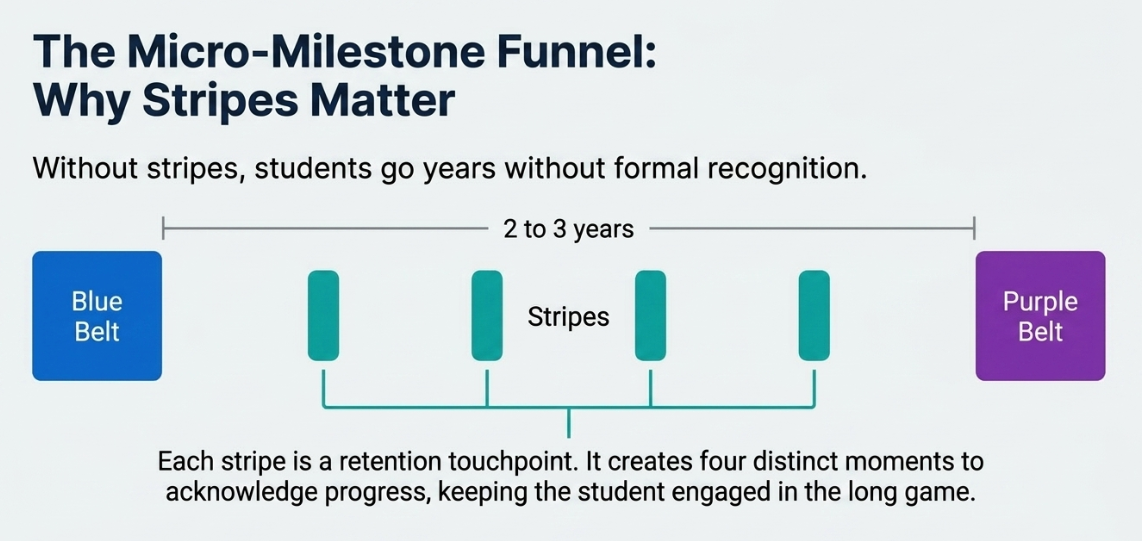
Stripes are the progress markers between belt promotions.
Each belt level (white through brown) uses a system of up to four stripes—small pieces of athletic tape wrapped around the black tip of the belt.
There's no universal standard for what each stripe represents. The IBJJF acknowledges stripes but doesn't define specific requirements for awarding them.
That means each academy—and often each instructor—has their own criteria.
Common approaches are technique-based (each stripe maps to a set of positions the student has demonstrated), time-based (awarded at regular intervals), or a hybrid of attendance milestones, technique assessments, and sparring.
For a full breakdown of how the four-stripe system works belt by belt, see our BJJ stripe system guide.
Most academies award stripes during a brief ceremony—either at the end of a regular class or during a dedicated promotion event.
The ceremony doesn't need to be elaborate. What matters is consistency: if students don't understand how stripes are earned, the system loses its motivational power.
For gym owners, stripes serve a critical function beyond recognition. They create four additional touchpoints between belt promotions—moments where a student feels acknowledged and sees tangible progress.
In a system where belt promotions can be years apart, those touchpoints are retention gold.
GYM OWNER TIP:
Standardize your stripe criteria across all instructors. If Coach A awards stripes based on attendance and Coach B awards them based on technique, students will notice the inconsistency—and trust in the system erodes. Write it down, share it with your team, and post it where members can see it.
Youth BJJ Belt System
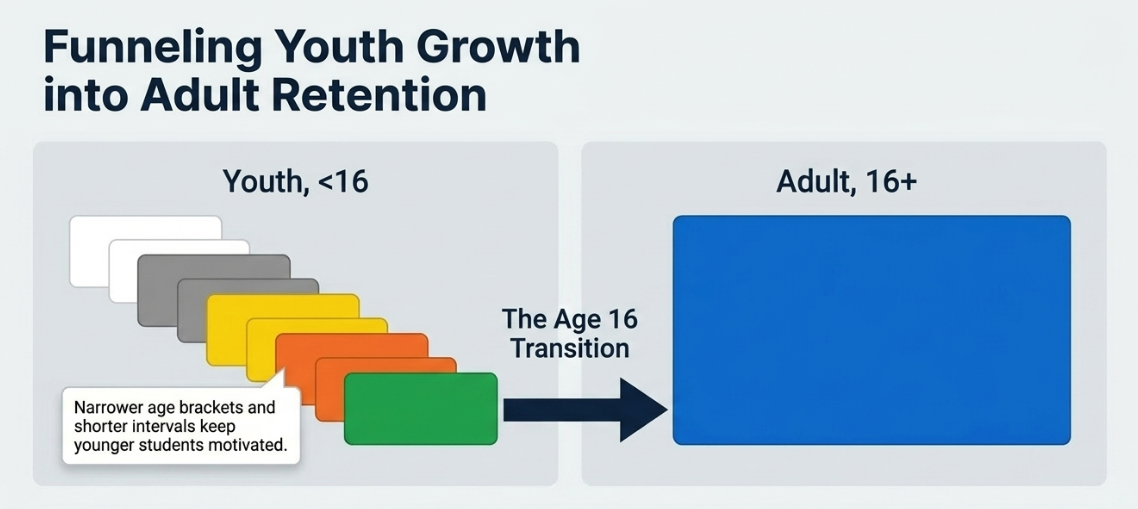
Kids don't follow the five-color adult ladder.
The IBJJF youth system—for practitioners under 16—runs through a longer sequence of white, gray, yellow, orange, and green (each in banded and solid variations), with narrower age brackets and shorter intervals to keep younger students motivated.
Each youth belt can also carry up to four stripes.
When a practitioner turns 16, they move into the adult ranks, most often converting a green belt to adult blue depending on age and academy.
Managing a kids program with that many belt colors and four stripes each is a real organizational challenge—for the full color-by-color breakdown, age bands, and Gracie-system variations, see our kids BJJ belt system guide.
PRO TIP:
Parents care about belt promotions even more than the kids do. Send a quick notification when their child earns a stripe or belt—a member portal that tracks rank progression gives parents visibility into their child's journey and makes re-enrollment conversations much easier.
BJJ Belt Progression Timeline
One of the most common questions from prospective and current students is "how long will it take?" Here's a consolidated timeline showing typical progression through the adult belt system:
Belt | Typical Time at This Belt | Cumulative Time from White | Min Age (IBJJF) |
White | 1.5–3 years | 0 years | No minimum |
Blue | 2–3 years | 2–5 years | 16 |
Purple | 1.5–3 years | 4–8 years | 16 |
Brown | 1–2 years | 5.5–10 years | 18 |
Black | Lifetime | 8–12+ years | 19 |
The IBJJF's minimum time-in-grade adds up to just 4.5 years from blue to black—two years at blue, 1.5 at purple, one at brown, with no time minimum at white—but very few practitioners hit those minimums.
Most spend significantly longer at each belt—especially at blue and purple—due to training frequency, injuries, competition experience, and each instructor's individual promotion standards.
Training frequency is the single biggest variable.
A student training five to six days per week will generally progress faster than someone training twice a week, though quality of training and retention of technique matter just as much as raw mat hours.
QUICK WIN:
Post a version of this timeline in your academy and reference it during introductory classes. Setting realistic expectations from day one reduces frustration and prevents the "I've been training for six months—why am I still a white belt?" conversation.
IBJJF Belt Requirements and Standards
The International Brazilian Jiu-Jitsu Federation sets the most widely recognized promotion standards, and most academies follow its framework as a baseline even when they aren't IBJJF-affiliated. The essentials:
- Minimum ages: 16 for blue and purple, 18 for brown, 19 for black.
- Minimum time-in-grade: two years at blue, 1.5 years at purple, one year at brown—with no minimum at white.
- Promotion authority: every promotion signed off by a registered black belt.
Two principles matter more than the numbers.
Time requirements are minimums, not targets—promoting at the exact minimum only makes sense when a student's skill genuinely warrants it, because rushing backfires the moment that student gets destroyed at their new belt in competition.
And competition isn't required, though many instructors weigh it.
For the full rulebook—promotion eligibility versus competition-belt rules, and the world-champion exceptions—see our IBJJF belt requirements guide.
Factors That Affect How Fast You Progress
Belt progression in BJJ isn't purely about time on the mats. Several factors influence how quickly—or slowly—a student moves through the ranks.
- Training frequency and consistency. This is the biggest factor. Students who train three to five times per week and maintain consistent attendance over months and years will progress faster than those who train sporadically. But consistency matters more than volume—two classes per week for three straight years beats five classes per week with frequent multi-month breaks.
- Quality of instruction. Not all mat time is equal. Structured curriculum, progressive drilling, and access to knowledgeable training partners all accelerate learning. This is where your academy's approach to the stages of learning makes a real difference.
- Competition experience. Competing forces students to execute under pressure against unfamiliar opponents. Many instructors consider competition performance—win or lose—as a significant factor in promotion readiness.
- Athletic background. Prior experience in wrestling, judo, or other grappling arts can accelerate early progression. A college wrestler might spend less time at white belt, but the advantage often levels out by purple.
- Age and physical attributes. Younger students often progress faster due to training frequency and recovery. But BJJ is famously accessible—practitioners in their 40s and 50s regularly earn black belts.
- Instructor's promotion philosophy. Some instructors promote on demonstrated skill alone. Others factor in character, teaching ability, contributions to the academy, and time. There's no universally "right" approach, but your students should understand your criteria.
PRO TIP:
Be transparent about what you value in promotions. If competition matters to you, say so. If you weight teaching contributions, make that clear. Ambiguity breeds frustration—especially at blue and purple belt where students are most likely to question whether they're progressing.
How to Manage Belt Promotions at Your Academy
Running a fair, consistent promotion system is one of the most important things you can do as a gym owner. It affects trust, retention, culture, and—let's be honest—whether students refer their friends.
Here's a framework that works:
Publish your criteria. Write down what it takes to earn each stripe and each belt at your academy.
This doesn't need to be a 50-page manual—a one-page document covering key techniques, minimum attendance, and any other requirements is enough. Post it on your website and hand it to new members during onboarding.
Run quarterly promotion reviews. Set a schedule—once a quarter works well for most academies.
Review every student's progress with your instructors, identify candidates for stripes or belts, and make decisions as a team. Ad hoc promotions during random classes undermine the system's credibility.
Standardize across instructors. If you have multiple instructors, align on criteria.
A student who trains primarily with Coach A shouldn't receive a different evaluation standard than one who trains with Coach B. Regular instructor meetings to discuss student progress keep everyone calibrated.
Track progression digitally. Keeping promotion history in your head—or on a whiteboard that gets erased—doesn't work past about 50 members.
A member management system that tracks attendance, skills, stripes, and belt history gives you the data you need to make fair decisions and spot students who might be falling through the cracks.
This is exactly the kind of operational challenge Gymdesk was built for.
Skills tracking, promotion history, attendance records, and member profiles all live in one place—so when promotion day comes, you're making decisions based on data, not guesswork.
Communicate after promotions. Send a message to promoted students acknowledging their achievement.
Even better—send a note to students who weren't promoted, letting them know what they're working toward. The students who don't get promoted are the ones most at risk of leaving.
Start a 30-day free trial to see how Gymdesk makes skills tracking and promotion management effortless.
GYM OWNER TIP:
Your promotion system is a retention system. Every stripe ceremony is a moment where a student feels seen and valued. Every missed promotion—without explanation—is a moment where a student wonders if anyone's paying attention. Build the process, follow it consistently, and your members will trust the journey.
Bringing It All Together
The BJJ belt system is deliberately slow.
White to black is an 8-to-12-year arc, and the ranks beyond it—brown, black, the coral belts, and the red belt worn by only five people in history—exist precisely to signal that the journey never really ends.
For students, that longevity is the appeal. For gym owners, it's the opportunity.
Every belt and every stripe is a promise you make to your members: train consistently, and your progress will be seen and marked.
The academies that grow are the ones that keep that promise the same way for every student—clear criteria, consistent standards, and a system that never lets someone's progress slip through the cracks.
Get the progression right, and the belt system stops being a ranking ladder and becomes the backbone of your retention.
Gym management software that frees up your time and helps you grow.
Simplified billing, enrollment, student management, and marketing features that help you grow your gym or martial arts school.


FAQ
BJJ Belt System FAQs

Josh is a martial arts educator and coach who bridges live training on the mats with evidence-based teaching. A 4th degree Taekwondo black belt and dedicated Brazilian Jiu-Jitsu practitioner, he’s spent years running classes, mentoring students, and helping instructors move beyond rote drills to training that actually works under pressure.
He holds a Master of Education in Teaching & Learning from Liberty University and runs Combat Learning, where he breaks down ecological dynamics, constraints-led coaching, and games-based training for combat sports. Through his writing and podcast work with Gymdesk, Josh turns coaching science and gym-owner stories into practical ideas you can use to run better classes and build a stronger martial arts school.